Showing posts with label how to catch a swarm. Show all posts

Tuesday, August 30, 2016

Do You Need To Combine A Weak Hive That May Not Make It Through The Winter?

We are David and Sheri Burns and we've been promoting beekeeping online for over a decade at: www.honeybeesonline.com

We are located in central Illinois and boy has it been hot and humid. We've received 5.40 inches of rain for the month of August. The average for our area is 3.5 inches. The extra rain has not only given way for more mosquitoes but some pretty hot and humid days. In late afternoon our bees are hanging all over the top and bottom of the hive trying to remain cool.

We have a few queens still for sale this week. Call us today after 10am 217-427-2678.

In today's blog, I want to encourage you to consider combining a very small and weak colony with a stronger colony before winter. Late summer and early fall is a great time to combine hives that are just too small to make it through a cold, windy, long winter.

Can you feed a small colony and help them survive the winter? Maybe, but it just depends on how small they are. I encourage beekeepers to feed all their hives in late summer and fall. Feeding bees protein and sugar can make a huge difference in winter survival.

Dangers Of Combining

If a weak colony just never took off this year there is a reason. That reason could be that the queen didn't lay well enough. But, it could also mean that your hive has a contagious disease. If you combine a sick hive with a healthy hive guess what's likely to take place. They both become infected. So you have to know alittle bit about beekeeping and why that weak hive is weak before you combine it with your prize winning, best honey producing hive ever!

My best suggestion is to be sure you do not visually see evidence of American foulbrood or European foulbrood. Then, what might really be hard to know is nosema, a microsporidian. Send some samples of your bees to the Beltsville, Maryland bee lab and they will sample for nosema for you. If all looks good, combining a weak colony with a strong one is a good idea.

Benefits Of Combining

You can always make a spring split if the combined hive overwinters well. And before you combine you will have to do something with that extra queen. Maybe you need her in a strong hive that lost their queen. Or you might sell her to a beekeeper needing a queen. Sometimes the extra bees from the weak hive, combined with a strong hive, can give the strong hive more leverage for overwintering provided that the strong colony does not have a high viral load from varroa mites. Watch our video below on how to combine hives.


BeeTeam6, A Popular Beekeeping Mentorship Service

Beekeeping has a huge learning curve. Wouldn't it be nice to have a Certified Master Beekeeper you could contact when you don't know what's going on? Bees do not always do what's in the beekeeping books. Sign up now so you can call me, email or text me your questions, photos or videos about your hives. This is a monthly service and you can cancel at any time.  

Last Class Of 2016
We have one last class for the 2016 year, our Basic Beekeeping course. Each October we offer a beginners course and it always fills up fast! Sign up now. 

This year we taught more classes and educated more students than ever before. We offered beginner classes, advance class, queen rearing, the Bee Institute, several "A Day In The Apiary With David" classes, Spring Management classes, "Getting Your Bees Through The Winter" and more. We'll be posting our 2017 class schedule online in October.

Sign up now for our Basic Beekeeping Course, Saturday, October 15th, 8am-1pm. We have 6 spots remaining.Click here 

Watch Our Newest Video Showing Two Ways To Catch A Swarm

Catching swarms is a great way to add more colonies naturally and at basically little to no cost. But, there is a skill involved.

Make sure capturing the swarm does not put you in danger of falling out of trees or off of ladders. Trying to gather $100 worth of bees is not worth a broken leg or worse. Be smart.

Be aware that swarms can leave again after you have given them the perfect home on your property. This is especially true if you captured them within 3 miles of your home. The scout bees probably already had another place in mind. They are still close enough to fly to it.


Are You Afraid To Harvest?
Honey FrameYou did it! Well, we should say your bees did it. They made some honey! But, are you now afraid to remove the supers and harvest the honey? Do you know all about how to harvest the honey properly from the hive? Here's some tips to help you have a great time harvesting that liquid gold!


Winter-Bee-Kinds


Winter-Bee-KindWinter is unpredictable.
If only we knew if it was going to be harsh or bad. Don't take a chance again! This time, be ready. Give your bees a chance. 
http://www.honeybeesonline.com/feeders/

Our Popular Late Summer
& Fall Feeder 
Burns Bees Feeding SystemAre you prepared to feed your bees when the nectar flow ends in a few weeks?  Got a plan? Two years ago we introduced The Burns Bees Feeding System. No more smashing pollen patties between hive bodies frames. Protective screens means no more bees everywhere when you change your feeding jars. Available for 8 or 10 frame hives.  Click Here For More Info
TWO HIVES
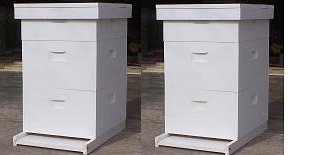
This is our best deal, two completely assembled and painted hives with wooden frames and foundation. Click Here For More Info.
               

Friday, June 12, 2009

LESSON 55: SWARMS, HOW TO MAKE A QUEEN INCUBATOR & MORE...


Welcome to Long Lane Honey Bee Farms! We are David & Sheri Burns, and we enjoy making a livelihood from bees. Now that it is June, our bees are really keeping us busy. It has been another challenging spring. We've had our share of rain and cool weather, but as the season progresses the weather conditions improve. We are producing lots of nucs and queens. We were issued a clean bill of health from our state's apiary inspection program through the Department of Agriculture, so we are happy about that! Now, I'm spending long days preparing the nucs. We sold over 60 nucs, so that's keeping me out in the bee yards all day long.

Our queens are doing great again this year, and filling up the brood area faster than we can keep new frames supplied for the queens to have room to lay. We are working hard every day grafting and raising queens! We are having very good results both in successful queen rearing techniques as well as the characteristics that we are seeing in our queens. Our queens orders are about a week behind but we are producing queens as fast as we can. It does take time to properly test the queens characteristics and make sure they are mated well. Queen rearing is a fine art. We have even added a few "trade secrets" to make our queens even better this year. We had to take the queens off our website due to demand out running supplies.
This is the time of year for swarming and we are having our fair share of swarms this year. No matter how many swarms we have, it is still beautiful to observe. A swarm is worthy of our full attention. Until you've stood in the middle of a swarm before, you can't say you've really experienced a swarm. My son was weed-eating and heard a swarm roar over the sound of the weed-eater!
Below is a video of a swarm that I shook from a tree near my nuc yard. Healthy hives swarm! Seriously, a reproductive swarm means that the hive was strong and healthy enough to produce another colony. Another reason bees swarm is because they become congested. Another "trade secret" that I will share with you, is that we overcrowd our hives and in so doing, they often become congested. I feel it is better to have a strong, crowded colony than a weak and struggling hive. Strong and crowded hives are more apt to resist pests and diseases. There is strength in numbers. As a result of the way we overcrowd our hives, we do have the occasional swarm like this one. Let me show you how I shake swarms from trees.


For the most part, swarms are not aggressive. I am occasionally stung by bees from a swarm but usually not. If you keep your hives near bushy trees like pines or a blue spruce, they usually land in the tree low enough where you can capture them and put them in a hive.
I learned something from an "old timer" beekeeper who said if beekeepers would stop chasing swarms and spend that time taking care of their own hives, they'd have better hives. I tend to agree with him. We have turned down most of this year's swarm calls. It just isn't worth it.
I' ve found that swarms like to land in my old ceder tree. This tree has been the resting place for many swarms over the last few years.

Not all swarms land low. Here's my oldest son, David, after he climbed a 30 foot tree with a Bee-Vac and captured a swarm that filled this entire holding cage. It was on the trunk of the tree and would have been impossible to remove without a bee-vac. We sell these, by the way.
The only reason I occasionally catch a swarm is to use it to draw comb. Swarms are good comb builders! Sometimes that's the only thing I use swarms for is to draw out foundation.
It's usually the old queen that leaves with the swarm, so when you catch a swarm it is usually a good idea to re-queen that swarm or it may not make it through the upcoming winter with the older queen.
In April, I flew down to Florida to shake packages and as you may remember from an earlier lesson, I mentioned that I was able to visit with commercial queen producer, David Miksa. In the April and May issue of the American Bee Journal, David was featured in a large article about his life long pursuit of producing queens. Every year I continue to sharpen my queen rearing skills and it is through knowing people like Dr. Joe Latshaw and David Miksa and others that I am able to improve my line of queens. I added about 5 different "survival" genetic stocks that I purchased from other parts of the US. I believe genetic diversity is crucial to very productive queens.
When I visited David Miksa, I was impressed with his incubator. When you produce large numbers of queens, you will need a place to hold sealed queen cells, especially when there is a bottle neck, say your mating nucs are still full as you wait for those queens to mate and to be used in hives or sold. What I like about David's incubator is that it has a glass door. And as we talked about it, he told me that it was just a glass door refrigerator. He added a heating element along with dual thermostats in case one goes bad.
Last year we used a "Little Giant" 9200 chicken egg incubator. They are around $50 and you'll need to keep your cells at around 92 degrees.


When I was at Sam's Club a few weeks ago, I noticed that they had a nice size, small, pop-can refrigerator just alittle over $150 with a glass door. With a glass door, you can more easily see your cells and monitor the temperature and humidity. It fits nicely under my counter.
I bought it and then removed the important parts from my 9200 chicken incubator and placed the heating elements and thermostat on a piece of plywood. Then, I placed the electronics on the bottom shelf of the fridge.
I wired the heating element up by routing it through the drain hole in the lower back part of the inside fridge. So, I didn't have to make any alterations to the fridge. So when I'm not raising queens, I can use it for an extra fridge.
You'll find as a beekeeper you can save lots of money by making your own incubator instead of buying one. Many queen producers make it even more simple by taking an old fridge, even one that no longer works, and simply place a low wattage light inside. You can wire the door switch so that the light is always on, and then put it on a thermostat to keep it around 92 degrees using a VERY low watt bulb. That's right, a light bulb will keep it warm enough. This works well too. There are lots of old refrigerators out there, and you may even fine one with a glass door.
I hope that by sharing insightful information about queen rearing, that more and more beekeepers may try their hand at it. It is quite easy and very enjoyable and rewarding, not to mention it can save you money from not having to buy queens when you need them. And by raising your own queens, you can also raise queens from the hives that you like best.
Also in this lesson, I want to WARN you to keep an eye on your queen. Inspect your hive every 14 days to be sure she is alive and laying well. If you lose your queen, your entire hive will all perish within 6 weeks, so be sure to keep an eye on your queen, and replace her with a new one at the first sign that she has perished.
Here's a picture of one of our "Pioneer Queens" this year. Also, I must stress how important it is that you replace your queen every year. When a virgin queen mates, she stores the sperm from the drones in her spermatheca. She usually mates with 15-20+ drones on a few mating flights. Because she stores the sperm, she will eventually run out. Then, she can only lay unfertilized eggs, which only makes drones, male honey bees. So by requeening your hive every year, you are insuring that she is able to lay strongly throughout that year and into the next spring.
People often ask me when is the best time to requeen a hive. Typically, any time is better than not doing it at all. Bees requeen their own hives whenever there is a need, so we can too. But I believe timing of requeening each year can produce different results. In other words, if your old queen is starting to not lay well in March, then by all means replace her so that you can have the results you want in March which is a better brood pattern, which means more bees. But, if you are replacing your queen simply because you want a younger queen, then you MUST do this after the turning of days (June 21).
Melvin Disselkoen became an EAS Master Beekeeper in 1986 and has worked bees for over 35 years. He wrote an article about outbreeding the mites. His research and explanation of outbreeding the mites makes real good sense, and it was while reading his work that I realized it is best to requeen after June 21.

His complete article on this can be found on his website at:


His point is that if you requeen after July 21, a new queen will outbreed the mites. The brood cycle of a mite is 13 days, and a worker bees is 16 days. Since a new queen after June 21 lays like a spring queen, she will out-lay the mites. Less mites means healthier overwintered colonies and better spring build up. That's a huge reason to wait until after June 21. Other reasons for requeening each year include: swarm reduction, stronger spring build up, better honey production due to increased spring foragers and more.
I've also been very busy preparing nucs. Some days I spend 12 hours a day working the hives to pull out 4 frames to meet our nuc demands. I'll be glad when the last of the nucs are gone! Here's a picture of my youngest son, Christian, after we packed up some nucs. These were a special order as you can see they are nucs, but they are all on medium foundation. Some beekeepers like using all medium size boxes rather than the larger deep hive bodies. We are happy to help out. Beekeeping is usually a skill based on knowledge, wisdom and experience. However, I've learned that making nucs is an art! It is not for the faint at heart.

I could go on and on, but I do want to address a very large problem within the beekeeping community. It's not CCD, though there are more cases of it than CCD, I'm sure. The problem I'd like to address is the disappearing hive tool. Where do they go? How can they disappear? Are aliens from other planets stealing our hive tools with some huge magnet from the mother ship? I doubt it. But I've solved my personal problem of lost hive tools. I bought a nice one! :)


Not only do I lose hive tools, but I leave them in the back of pickup trucks or on top of a hive, and because they are metal, they will rust. Leave one on the ground all winter, and it will almost rust away by spring.  Click here to go to our online store for this item. 
If you are still needing hive equipment you can order it online or give us a call. Our contact information is below. Thanks so much for following these lessons!
Until next time, remember to Bee-have yourself!

David & Sheri Burns
Long Lane Honey Bee Farms
217-427-2678