
Sunday, November 28, 2010

LESSON 88: BEE THANKFUL

DavidSheriNew

Sheri and I would like to extend a warm greeting to you and your family! And a very Happy Thanksgiving weekend! We hope you enjoyed family, friends, some good food, and some restful days from work.

I know our family enjoyed being together and sharing some great food and wonderful fellowship together.

CandleSpeaking of getting together, we still have some openings for those who are interested in attending our first 2-hour beekeeping short course. Register ASAP by clicking here. This course is December 3rd, this coming Friday night at our honey bee farm. Angela Faulkner will be presenting candle making and my wife Sheri will be demonstrating how to cook with honey. We’ll also have many different types of honey to taste sample. Join us for an enjoyable evening, this Friday night!

Today’s lesson may not seem like a lesson, but actually I believe it is a powerful life lesson indeed. I want to speak about the importance beekeeping can have in helping to make our lives complete. Then I want to speak about the importance of beekeepers working together in unity and kindness to help support the beekeeping community.

Bees greatly enrich our lives. As a pastor, most of my life has been spent helping people through many challenges in life. People who have struggled with life’s most challenging blows, poor health, family issues, unemployment, marital issues, and the list goes on.

When life throws us a curve, we may fall into despair and hopelessness. Life is good, but life can be hard at times, sometimes more than we can bear. During these times of struggle we can become overly engrossed in our woes. During these moments of heartache and depression, beekeeping can be very therapeutic.
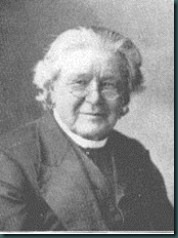
Lorenzo_LangstrothThe current hive that is standard throughout the beekeeping community was designed by Rev. Lorenzo Lorraine Langstroth (1810-1895). His books and writings appear as if written by the lead entomologist of our day. Without the modern day University labs, Langstroth made life-changing discoveries about the bee and the construction of our current bee hive. Yet, Langstroth had bouts with depression, and when life drove him into some deep moments of despair and hopelessness, he poured himself into his bees. The entrances to his hives were the doorways into comfort and peace.

IsraelI’ve traveled to Israel 5 different times and remember listening on the news to Israel’s former Prime Minister, Ariel Sharon, giving a speech to the UN General Assembly in September, 2005. Part of his speech really left an impression on me. “I was born in the Land of Israel, the son of pioneers - people who tilled the land and sought no fights - who did not come to Israel to dispossess its residents. If the circumstances had not demanded it, I would not have become a soldier, but rather a farmer and agriculturist. My first love was, and remains, manual labor; sowing and harvesting, the pastures, the flock and the cattle.”

For most of us, there is a desire to return to the land, to enjoy fresh air, feel the fertile soil between our fingers, to sow and harvest…manual labor. But life’s circumstances have demanded we do other things.

ChristianStill, there is something in us that is restored and healed by the wind blowing through our hair, the sun in our face and the pleasant sounds of nature. Our soul is replenished by the smell of fresh flowers, freshly cut grass or newly plowed soil. Beekeeping is an outlet. An escape from our demands, problems and troubles and a return to that which can truly enrich our lives, nature at its best.
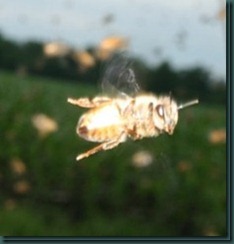
beeflyingI cannot imagine my life without my bees. Some people watch TV and some attend sporting events for entertainment. But for me, nothing is as entertaining as watching my bees navigate the skies with their payloads hour after hour. Nothing keeps my mind sharp and expanding like learning about the honey bee.

Whether you ever make a profit from your bees or not, beekeeping brings about a completeness; a satisfaction that few things can offer.

BEEKEEPERS WORKING TOGETHER
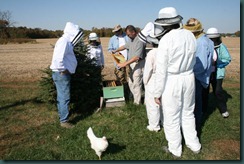
Lesson88Ask ten beekeepers the same question and you’ll get eleven different answers. There has always been a distinct individuality about beekeepers. Perhaps it’s the long hours we spend in solitude working our bees. Maybe it’s because the general public can’t understand why anyone would mess with stinging insects. For whatever reason, we are unlike the social insects we keep.

It’s time we take a hint from the bees and learn to work together as a beekeeping community. We need each other. The old saying, “divide and conquer” is certainly true. But a united community of beekeepers is a powerful force.

Like all groups of people, there can be competition, a drive to be better or smarter, and personality clashes can divide. However, as beekeepers we must remember what is at stake…the honey bees. Could our bees be showing us that we must work together?

I want to give 5 important tips to help us work together as a beekeeping community.

1. Avoid being the “know-it-all” that has to show off in front of new beekeepers or less experienced beekeepers. There is a temptation once a beekeepers learns about bees, to show off, to try to appear like the big kid on the block. Instead, just be glad that you are learning and remember that you still have much more to learn. Be humble, not prideful.

glands2. Respect the recent, reliable studies. Pass up the opportunity to discredit  proven scientific studies. I regularly find beekeepers who have nothing good to say about University Entomologists and their findings. They accuse these bee specialists of being unable to relate to the real experiences of beekeepers; people who sit in ivory towers and never experience beekeeping like the rest of us. That’s not always true. And as a result of this poor view, some beekeepers will reject all studies and miss out on new discoveries. Be open minded and appreciate what our entomologists are doing.

Lesson84b3. Speak positively and have a positive outlook when speaking to the public or with beginner beekeepers. Those interested in beekeeping often will seek out an experienced beekeeper and ask many questions. Sometimes the experienced beekeeper will discourage the newbie and tell them it isn’t worth it. Instead, be positive and encouraging. Offer to help mentor and spur them on.

4. Be kind and gentle when other beekeepers do things differently than you. When someone is doing different things, don’t automatically assume their ways and techniques are dumb. Respect their exploration and new trials. Who knows, maybe something will be discovered serendipitously!

lesson88a5. Become involved in local and state meetings. Fight the urge to be a lone beekeeper! Branch out and mill around with other beekeepers. You still have much to learn! So take opportunities to hear new ideas and opinions from others who love bees just as much as you.

After our last in depth lesson on Varroa mites, I hope you’ve enjoyed this lesson…some food for thought.
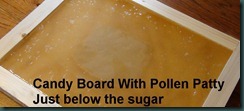
Candyboard4Do not forget to put candy boards on your hives around December 22. Less than a month to go. If you need to order your candy boards, click here.

Spacer77We also are offering a winter wrap kit that is essentially an upper vent/spacer, and a sheet of felt paper to wrap around your hive. Your candy board can be placed on top of the winter vent spacer which allows moisture to still be reduced while the candy board is on. Click here for more info on this winter wrap kit.

Thanks for joining us today and I hope to see some of you this Friday!

Meanwhile Bee-Have Yourself!

David & Sheri Burns
Long Lane Honey Bee Farms
14556 N 1020 E Rd
Fairmount, IL 61841

217-427-2678

Website: www.honeybeesonline.com
Podcast:
http://itunes.apple.com/us/podcast/studio-bee-live/id400801201

EMAIL: david@honeybeesonline.com

ONLINE STORE: www.honeybeesonline.com

Friday, November 19, 2010

LESSON 87: PESTS & DISEASES PART 3 VARROA MITES

smalldavidatbarnHello from Long Lane Honey Bee Farms in central Illinois. We’re David and Sheri Burns and now the 2011 bee season preparation has started. Package bee orders are pouring in. Orders for woodenware and bee supplies all point to the bee season is underway. in 5 days we sold 1/4 of our available packages. Unbelievable! I so much enjoy answering the phone and meeting other beekeepers or beekeepers-to-be.
family1Here’s a picture of our family. Sheri and I have six children ranging in age from 28 years old to 3 years old. Three girls and three boys. Almost everyone in the picture has helped us in our bee business, even Grandma and Grandpa in the back row. We’ve worked hard to establish Long Lane Honey Bee Farms and we want to thank all of you who have blessed us with your business.
Throughout most of the US beekeepers have put their bees to bed for winter. That is merely a figure of speech because bees do not hibernate during the winter. Instead, they cluster, remain calm and eat small amounts of honey and pollen to make it through the cold winter months.
nucWe have heard back from so many customers who love our queens, nucs, packages and woodenware, and we appreciate that. So many people are requesting our 4-frame nucs for spring.
These are little colonies that we make up in the spring with our queens on 4 frames of honey, pollen, brood and bees. A day does not go by without someone wanting to order nucs in advance.
nucs
ituneimage
LESSON 87: PESTS & DISEASES PART 3 VARROA MITES
Today I want to educate you on the varroa mite, but I do not want you to become discouraged or defeated by this honey bee parasite. We can keep bees even with varroa mites. Mites are everywhere in our world. You’ve probably got a few in your house and probably on you at one time or another, such as chiggers or dust mites. So do not become a hypochondriac about your bees having mites. Do not freak out or overreact. There are many approaches to dealing with mites. But, for  you to be a successful beekeeper, you need to be well informed about Varroa destructor.
HISTORY OF VARROA DESTRUCTOR
The varroa mite was first introduced into our country in 1987, although the literature identifies the spotting of one varroa mite in Maryland in 1979. Since 1987 mites have spread rapidly throughout the US.
The mite was first identified as Varroa Jacobsoni but later correctly identified as Varroa destructor (Anderson and Trueman 2000). It is the number one killer of honey bees in the US. As an ectoparasite  (lives outside of the honey bee) it is one of the largest parasite on the planet compare to its host.
It is not a natural parasite to our honey bee, Apis mellifera. It’s original host was Apis cerana. But, like many pests, it jumped species and Apis mellifera was not able to cope well and most feral colonies, wild hives, were destroyed by the mites in the early 1990s.
LIFE CYCLE
Miteondrone1Varroa mites are tiny but visible with the naked eye. In this photo, I pulled out a drone pupa and you can see the tiny mite on the lower abdomen of the drone. The mites that we see on our bees are the adult, female mites also called the foundress mite. These adult females are dark, reddish brown in color. Male mites are never seen outside the cells and they never turn dark but remain white or a light color. Mites only reproduce in the sealed cells of a bee hive, never outside the hive.
The varroa mite enters a hive through the front entrance, riding on other bees. Drones are allowed to enter any hive and drones are common carriers of mites, transferring them from hive to hive. Once in the hive, the adult, foundress mite will look for a young nurse bee and climb on her back and will latch on to the thorax where the wings attach or just behind the head. Mites feed on bee blood, known as hemolymph.
Because the bee is exoskeleton, the mite cannot penetrate the outer plates of the bee so it moves to the overlapping segments of the abdomen to the soft tissues and pierces through with its mouth parts. These areas on the honey bee are known as the innersegmental membranes.
When the bee larva is 8 days old it gives off distinct pheromone signal to adult bees who begin to seal the cells. However, that same pheromone signal is picked up by the varroa mite as an indication that it is time to enter the cell.
The mite makes her way into the bottom of the cell and buries herself beneath the royal jelly in the base of a cell.  Mites have a snorkel like apparatus that they use to breathe while hiding under the royal jelly. These specialized tubes are called peritremes and are thin, pale-colored tubes located just between the last two pairs of legs.
Once the cell is capped and the bee larva has spun its cocoon the mite will feed on the larva and will begin laying eggs about 3 days after the cell is capped. Most female mites lay between 4-6 eggs, the first being a male mite, and the remaining 4 being females that mate with their one brother in the cell.
Unlike bees, mites do not go through larva and pupa stages, instead they go through 4 developmental stages: egg, protonymph and deutonymph stages and finally adult. From egg to adult takes 6-7 days for females and 5-6 for males.
Mites will pierce an opening in the prepupa honey bee larva and the whole family of mites will feed from that one wound. As the family grows and the bee emerges, the foundress mite will leave the cell with one or more new female daughters. The males die and never leave the cell and the bees clean them out. The adult females will then attach to adult bees for an average of 7 days before finding a new cell to enter and reproduce again. During her lifetime the foundress mite will go through 3 reproductive cycles.
IMPACT ON THE COLONY
The impact of varroa mites on a colony varies depending on the level of infestation and the level of diseases the mites may carry. Several mites in one cell can seriously cripple the developing bee, through the loss of blood, injury or spread of disease. Mites can also negatively impact adult bee. An adult bee can have trouble flying and Deformed Wing Viruscarrying out normal work when they have more than 2 mites on them at one time. Mites vector several diseases as they feed on bee hemolymph. A common disease that is spread is Deformed Wing Virus (DWV).  Bees with deformed wing virus are easy to identify and gives evidence to the high level of mite infestation in the hive. The wings appear burnt or deformed.
NATURAL TREAMENT
liquidnitrogenWe prefer not to use chemicals in treating for mites. Instead our first line of defense is raising queens that are VSH, Varroa Sensitive Hygienic. These bees detect mites below the sealed brood and remove the pupae and mites, taking them outside the hive. In the photo,  Liquid Nitrogen is used to kill a circle of brood and then it is measured in 24 hours to see how much of the dead brood was removed. This identifies a VSH trait in a colony.
GreendronecombThe next natural line of defense is trapping. Green drone comb can be placed in the hive. Since drones are the longest to develop, 24 days before they emerge, mites prefer drone cells so they have longer to try and reproduce more female mites. Once the drone comb frame is sealed, it can be removed and frozen for 24 hours killing all the mites, and drones too of course. Then, the comb can be placed back in the hive to be cleaned out by the bees and the process repeated.
The third level of natural defense against mites is the use of a screen bottom board. Since mites are parasites, they do lose their grip. Sometimes they are groomed off of bees by other bees and when they fall, they fall through the screen bottom board. It is effective, just observe the number of mites that fall through the screen. Once out of the hive, they do not move and therefore cannot feed and die below the hive. Not all mites will fall out of the hive, but those that do will decrease the colony’s mite load.
A fourth plan of attack is to treat the hive with powdered sugar or confectionery sugar. Shake one cup of powdered sugar per deep hive body. Let it fall between the frames. The powdered sugar causes the bees to groom mites off and some mites just lose their grip and fall. This should be repeated once a week for at least 3 weeks.
A final natural defense against mites is to break their own brood cycle. By pulling out the queen for 2 weeks, the mites cannot reproduce and are greatly reduced. The lack of bee brood removes the mite’s hosts.
CHEMICALS
More and more chemicals are available. Some chemicals in the past have show to have negative effects on the drones and queens reproductive organs. However, newer chemicals have shown to be more effective with less side effects. We recommend that you carefully research each chemical that is available and make your own decisions about using chemicals in your hives.
Now you probably know more about mites than you ever wanted to know, but keep this teaching handy because it can give you greater knowledge to help your bees not succumb to the mites.
These Words Might Be New To You…
Hemolymph  -  Bee blood
Exoskeleton – Bees have a hard outer covering rather than an internal
                     skeleton.
Ectoparasite – A parasite that lives on the outer surface.
Phoretic stage  -  Adult Varroa mite
Protonymph – A newly hatched mite
Deutonymph – The last stage prior to the adult stage.
Foundress – Female egg laying mite

TESTING FOR MITES
Some suggest placing a mite collection sheet, sticky board, beneath the screen bottom board for 1 day and then counting to see if more that 25 mites can be counted, exceeding the economic threshold requiring additional action or treatment.
However, I have found visually inspecting phoretic mites on adult bees and inspecting mites on drone purpae gives a better picture as to the extent of mite infestation. Obviously, we must also inspect the bees for mite damage or vectored diseases from mites that show up in the colony.

Thanks for joining us today and please check out our contact information and contact us soon! We’d love to hear from you:
Long Lane Honey Bee Farms
14556 N 1020 E Rd
Fairmount, IL 61841
217-427-2678

www.honeybeesonline.com
Until next time, Bee-Have Yourself!
David & Sheri Burns


Wednesday, November 10, 2010

Lesson 86: Package Bees, How To Winter Wrap A Hive & DEC 3rd Class Candle Making & Cooking With Honey & Honey Sampling

dnsHello everyone! And welcome to another beekeeping lesson from David & Sheri Burns at Long Lane Honey Bee Farms. We’re glad that you have landed on our site. Where else will you receive such detailed and fun information on keeping bees?
In today’s lesson, I’ll teach about package bees, and share a detailed teaching on wrapping hives for winter along with a video of how to do it.


LESSON 86: PACKAGE BEES & WINTER WRAPPING A HIVE
Tens of thousands of packages of bees are shipped to beekeepers throughout the US every year. Bees have been shipped through the postal service for over 100 years and is very successful. Some speak poorly about the stressed placed on bees shipped through packages and suggest that local nucs are better. I’ve addressed this in previous lessons. Our great country provides us with various climates. The southern climate allows us to get a jump on raising bees and queens for northern beekeepers. This has always been the motivation for providing packages, and northern beekeepers have always been grateful. Packages can be produced in early April in the southern states, but nucs aren’t available in northern states until May-June.
All of the southern package producers that I know work hard to make winter hardy stock queens. I’m also a nuc provider so I understand why some people prefer nucs. However, I love packages! I remember when I received my first 2 packages in the mail. Wow! What an exciting time. I thought it was the coolest thing that the post office delivered my bees to me, and they did great.

NOW LET’S TALK ABOUT WINTER WRAPPING A HIVE
Typically, bees do not need to be wrapped for winter. We are in central Illinois and our hives get along fine with open bottom boards and no wrap. Bees do not heat the inside of their hives like we do our homes. Instead, bees do not heat the inside of their hive, they only keep their cluster warm. Parts of the hive away from the cluster are as cold as it is outside.
Even with your best winter preparations, it will not be enough if your bees have a mite infestation or are lacking stored honey. Make sure your colony is disease free and is not infested with varroa or tracheal mites. Then, make sure your hive has an ample supply of stored honey and pollen. A winter hive wrap is useless if these important things go unchecked.
Something negative happens when a hive is wrapped. The extra wrap can allow the bees to warm the inside of their hive so much that on a very cold day, excessive moisture will accumulate on the inner cover or top cover. This cold water will drip down on the bees, causing them to become too cold and wet, and eventually perish. The excessive moisture in the hive can also cause the growth of mold and bacteria.
Two precautions must be taken when wrapping a hive for winter: 1) The hive must be given an upper entrance. This is especially necessary in regions that receive several feet of snow per year. The upper entrance will allow the bees to take cleansing flights even if the hive is buried in a snow drift. 2) The hive must have upper ventilation. Upper ventilation will help deplete away excess moisture condensation from the top of the hive.
Spacer77We now make a special spacer that has the upper ventilation and upper entrance all in one. We are selling the winter spacer with black wrap paper for $10 and what is neat is that they also accommodate our winter candy boards. CLICK HERE TO ORDER. In the video below, I will demonstrate how the candy board sits directly on top of the upper vent/entrance spacer. And this spacer can also be used so provide space for pollen patty feedings or bags of sugar water as well. It can also be used when medicating your hives. These spacers have lots of uses! Enjoy the video on wrapping hives.

Winter Wrapping A Hive
For those who may not have been able to play the video, let me walk you through the steps in the pictures below or CLICK HERE to watch the video from our website:
spacer2I’ve chosen to use a very common material known as roofing paper or black tar paper available at most home improvement stores. A common width is 36”. I like 36 inches because most hives are two hive bodies deep which means the hive is approximately 22” tall. However if the hive has a super, it makes it about 28 inches tall, and two supers puts it right at about 36 inches tall. So for the purpose of this hive, 36” width is perfect.
Next, cut your piece of roofing paper at around 80-85” long. This will allow you to wrap it around your hive and overlap. Overlapping a few inches is critical, especially in windy places. If the wind starts to pull the paper, it could rip it off over the course of a windy winter.
spacer5It is important to insert your front entrance reducer, your top entrance spacer and place your candy board on for added food.
spacer4Your bottom entrance reducer should be on its smallest setting. The entrance on the upper spacer can face the front or the back. I place it in the front so that I can work my bees from the back.
spacer6Now we are ready to wrap. Start on one side and use a hand stapler to fasten the paper to the hive. If you are concerned about staple holes, you can use duct tape or gorilla glue. Wrap the paper along the side, and around the back, stapling as you go, along the other side and across the front. If the bees are flying, you will disrupt their landing and take off and they might let you know about it. You can also wait until a much colder day when the bees are inside and clustered.
You’ll notice I had to notch a small cutout for the opening in the front, both at the bottom and at the top. Once the paper is stapled or taped down, you can put your top on. It might fit tight, but just make sure you get the paper under the lid to help hold it down tightly in high winds.
spacer7You’ll notice the top entrance is just below the lip of the top cover minimizing rain and snow from going directly in. However, small amounts of weather will not bother the bees in this upper placement.
You did it, and it looks nice. You’ve given your bees an upper entrance/exit and you’ve given them a nice upper vent. And you’ve wrapped your hive to help keep out excessive winds that might leak through cracked and broken boxes.
Although we rarely wrap out hives, we do enjoy experimenting to see if wrapping does make a difference. So the hive in the picture/video is one that we’ll follow along all winter to see how it does. The queen in this hive has some very unique characteristics in storing honey and pollen, and so we are anxious to observe her overwintering skills. This hive is a 5 year old survival hive that has not been treated with any medication for the last 5 years. It had mites all year, but no signs of infestation and no apparent negative effect. It does not have tracheal mites going into winter. Currently the cluster is very low in the hive with about 60 pounds of honey on board.

Thanks for joining us for another lesson in beekeeping. Our next lesson will be an extensive lesson on Varroa Mites. See you then.
Here’s our contact information:
Long Lane Honey Bee Farms
14556 N. 1020 E. Rd
Fairmount, IL 61841
(217) 427-2678
Email:
david@honeybeesonline.com
CHECK OUT OUR PODCAST: www.honeybeesonline.com/studiobeelive.html

See ya next time,
David Burns
EAS Certified Master Beekeeper


2010 Package Bee Work

Saturday, October 30, 2010

Lesson 85: Special and Unusual Beekeeping Items


Lesson 85: Special & Unusual Beekeeping Items
For those just getting started in beekeeping there is a learning curve involved. How do you pronounce “propolis”? Is the first vowel long or short. What is a frame? Do you call a hive body a deep hive body, a brood box, a deep super or what? But, after you’ve been in beekeeping a while, it’s old hat after awhile. Soon you sound like a university entomologist. But just when you think you have a good handle on the fundamentals of beekeeping essentials, suddenly you realize there are many more pieces of equipment that you’ve never seen or heard of before.

That’s because beekeeping is that way, like most hobbies…there is always more to buy. Obviously, the back yard beekeeper doesn’t need all of these specialty items. Some are a waste of money and really aren’t useful, but others are a big help and can save money in the long run.  So my wife encouraged me to write a lesson highlighting some of these strange and unusual items in beekeeping that aren’t so common among most beekeepers, but it’s fun to know what they are and how they are used.

Top FeederMy first piece of equipment is a funny round shaped item. A fellow beekeeper donated a large amount of equipment and this was in the mix. It puzzled me when I first saw it. I spent a few minutes wondering if it was part of a larger item or not.  What do you think it is? It was purchased from a Canadian vendor at a bee conference. Look at the photo and try to guess.
Okay, click on the video below as we walk into my apiary and look inside the hive to see how this item is used.

Video of Top Feeder
I always enjoy learning something new about beekeeping. This item is a top feeder that fits over the winter cluster. Fill the reservoir with 2:1 sugar water, then put the plastic cup around the center and then the plastic lid on the top and sit it on top of the frames as shown in the video. Works great and you can probably feed your bees this way until it becomes so cold that the sugar freezes.   In real cold weather I would advise placing your inner cover on your hive, and then placing this top feeder over the oval shaped hole on the inner cover. The inner cover will prevent the warmth the cluster is producing from rising up and away, but he hole in the cover will still allow the bees to access the feeder.
capping scratcherOur second item should be easier for most beekeepers to identify. Take a look. Do you know what it is? Looks like a hair pick. It' is actually a capping scratcher.   Some beekeepers use this tool to open up cells on sealed honey comb. Others use it in places where the heated knife did not cut open all the comb cappings. This stiff pick will open up all the sealed honey comb for extraction.
Cell protectorHere’s a harder one. What is this? It’s orange and has lots of holes that hold little cups.  Any idea?  It is a queen cell protector used in shipping queen cells. Almost ripe queen cells are placed in the small cups and the plastic cups are then placed in the orange holder. The bar is then placed in a shipping box with air vents, bees, water and sugar to care for the cells during shipment.
Conical Bee EscapeWhat in the world is this? Have you ever seen anything like it before. Can’t believe it would be used in a bee hive? It is. In fact, many beekeepers like these a lot. Do you know what it is?
It is a conical bee escape board.  Place it under your supers and above the brood area and the bees will walk through the small, red, conical (cone shaped) pieces but will not walk back in due to the opening being small at the tip. This conical bee escape has two rows of conicals with 5 on each side. conical bottomHere’s a picture of the bottom and you can see how the bees can easily walk into the groove and out of the red conicals.  Keep in mind that the proper way to place this on the hive is with the red conicals down closest to the brood area.
It’s an effect way of clearing out the bees from honey supers before removing them from the hive.
Mouse GuardPut on your thinking caps for this one.  What do you think this piece of metal could be?  Notice it is L shaped and has holes in it. It is not a frame rest. Ready for the answer? It is a mouse guard. You place it in the entrance of a hive and the bees can fly out and in through the holes but not mice.
slatted rackNext item please. Look at this. All those little rails. What do you think about this piece of equipment. Some beekeepers love them. Some claim it prevents swarming. It’s called a slatted bottom rack or a slatted rack. It fits on the top of a bottom board just below the bottom deep hive body. Carl Killion used a similar idea to allow space for bees and extra ventilation. C. C. Miller believed in the idea but he simply made 2” bottom boards but found that the slatted rack2bees would build comb on the bottom of the frames to fill the extra space provided. But with a false bottom, the bees are tricked no to build comb.
People are always confused which way to place these on the hive because on one side the slats are close to the top and the other side they are a over an inch away. Place it on the hive with the slats as close as possible to the frames.
combcuttereFor our next strange and unusual item we have a metal item with a handle. If you’re good in the kitchen you may want to pick this up and use it like a cookie cutter. You are close, but it’s not a cookie cutter. Instead it is used to cut comb honey. It is sized just right to cut comb to fit into the plastic provided containers. It’s a comb cutter. Remember if you are going to make comb, use the then rib comb foundation or no foundation at all. Even most wax foundation has embedded wire. This will not be tasty for your customers to bit into a wire.
Bee EscapeHere’s one that is sure to stump the biggest beekeeping know-it-all. What is this? Looks confusing doesn’t it. Complicated. Hmmm… Do you know what it is?
It is another bee escape! It is called the Triangular Escape Board.
screenYou will not believe how it works. What I’m about to tell you is unbelievable, but it is true and tested.  Bees would not be able to be NASCAR drivers because they don’t like to go left when faced with a wall. I’m not kidding. The way this escape works is that bees will easily walk out by taking right turns, but will not go back in through the openings. It is another way to clear out a super of all bees before taking it off. Amazing!  Bees are amazing aren’t they. Place it on the hive hive with the screen facing the brood area.
queenmansionMy last item looks a lot like a regular deep hive body. But notice some things are different. There are three sections to this deep hive body. Why would a deep hive body have three sections? We started making these last year and it continues to be a popular item. It is a deep hive body that has been converted into three sections to either be a queen mansion where you can raise three queens in one box or you can have 3 separate 3 frame nucs in one box.
queen castleTake a look at the inside. Notice each section is completely sealed off from the other so the queens and bees cannot make contact. Their entrances are unique to their compartment around the sides and back so that each section has its own entrance. Also, it has a screen bottom board and this is important for small nucs in the summer heat.
queen castle nuc 2

We would like to hear from you!  We’d like for you to call us and speak to our answering machine on Saturday or Sunday and either ask a question or tell us why you appreciate what we do and then we’ll play it on our next podcast! 217-427-2678. Just call any Saturday or Sunday and leave your name (first name and state) and your message or feel free to ask a question. We’ll answer all questions on our next podcast.

Here’s our contact information:

Call us at 217-427-2678  (8:30-4:30 Central time Mon. – Fri.)

Recorded questions or comments for podcasts: Call Sat. or Sun. anytime and leave your message to be played on our podcasts
Email us at: david@honeybeesonline.com
Mailing address: Long Lane Honey Bee Farms, 14556 N. 1020 E. Rd,
Fairmount, IL 61841

I no longer check my dburns@tswireless.net account so please only use david@honeybeesonline.com if you need to email me.
Take care and until next time, bee-have yourself!

David & Sheri Burns
Long Lane Honey Bee Farms

Thursday, October 21, 2010

LESSON 84: FALL COOKING WITH HONEY & MOUSE PROOFING YOUR HIVE FOR WINTER

dns
Hello from David & Sheri Burns at Long Lane Honey Bee Farms in central Illinois. In today’s lesson, Sheri will be giving insights into cooking with honey. Now that it’s fall and the holidays are approaching and holiday meals to plan out, why not spice things up with some honey?
Then I’ll share some techniques to mouse proof your hives. Mice in the hive can be a real problem, so be sure to put up a good defense. You can have great bees that are healthy and ready for winter, but the mice can take them out.
We are in the news again. FULL ARTICLE
David10 


JeffHarris In this photo I’m talking with Dr. Jeff Harris of the USDA BEE LAB at Baton Rouge, La.  Dr. Stu Jacobson, Phil Raines and myself continue to lead the way for the Illinois Queen Initiative, a program designed to promote the development and adoption of disease and mite resistant honey bees and queens that survive well and are productive under Illinois conditions. We had our yearly meeting at the Grand Bear Lodge in northern Illinois over the weekend and we enjoyed Dr. Jeff Harris as our main speaker. Jeff first worked on the Suppress Mite Reproduction (SMR) honey bee along with Dr. Harbo, which are now called VSH, Varroa Sensitive Hygienic bees. These bees are able to detect mites under sealed brood and remove the mite infested pupa. Jeff continues to preserve and research the VSH queens.


LESSON 84: FALL COOKING WITH HONEY & MOUSE PROOFING YOUR HIVE FOR WINTE
Hi, it’s Sheri and I want to talk to you about cooking with honey.
Don’t you just love this time of year? The leaves are turning brilliant colors, pumpkins and colorful gourds adorn porches, the fields are being harvested and the sky is crystal blue and the air crisp. You, the beekeeper, have just finished extracting that liquid gold. You have gallons of it. What do you do with it now? Sure, you know it’s great in your coffee, tea, and toast, but what else?
October autumns are a great time to talk about cooking with honey. This time of year comes with lots of special treats like apple cider, pumpkin pie and caramel apples. Some of our most favorite foods for this season can easily be made with honey. Any recipe that calls for sugar can be substituted with honey. It isn’t an exact ratio, i.e.: if your recipe calls for ½ cup sugar, then you use ½ cup honey. But with a little tinkering, or a really good cookbook, you can make delicious fall-time foods.
UncapperHoney, in its unadulterated, raw, pure state is a superior food. It is all natural, loaded with great enzymes and antioxidants (as long as it’s not heated up), tastes sweeter, and makes foods more moist. Foods made with honey also last longer and freeze nicely.
Give the trick-or treating kiddies a treat with these popcorn balls:
¾ c sugarfamily picture2
1 tsp salt
½ c water
¾ c honey
3 quarts popcorn
Cook sugar, salt and water (stir until sugar is dissolved) to a very brittle stage of 300 degrees. Add honey slowly, stirring until blended. Cook again until thermometer registers 240 degrees. Pour over popcorn and form into balls. Wrap in heavy waxed paper.
Who doesn’t love pumpkin pie? Piled high with whipped cream, it is the symbol of autumn. Try this one at your next gathering:
½ c dry milk powderhoneysales
½ tsp ground ginger
1-1/2 c cooked pumpkin
1-1/4 c water
1 tsp vanilla
½ tsp salt
1 tsp cinnamon
3 eggs beaten
1/3 c honey
Mix dry ingredients. Add pumpkin, eggs, water, honey and vanilla. Pour into unbaked pie shell, bake at 450 degrees for 10 minutes. Then reduce heat to 350 degrees and bake 30 – 35 minutes longer.
Baked Boneless turkey breast
Boneless Turkey breastbearding
½-1 c honey
breading of your choice
Pound turkey breast until thickness desired. Roll in honey. Coat with breading. Bake or fry as desired.
Turkey marinade
½ c honeyLesson84ee
½ c brown sugar
2 tbs mustard
½ c ketchup
Juice of 1 lemon, or orange
¼ c olive oil
Mix all ingredients. Feel free to add other ingredients as you wish, such as salt, pepper, parsley, onion flakes and chives. The more the merrier when it comes to marinade.
This is great grilled!!
Experiment with honey instead of sugar in your favorite wheat bread recipe. Chocolate chip cookies made with honey instead of sugar are moister and keep longer. Add it to Greek yogurt or drizzled over ice cream. Heat up a mug of spiced cider with honey. Experiment this winter with your fudge and candy recipes. Whatever you do, it’s good!
Thanks Sheri, and now you know why I have to run 3 miles a day to stay in shape. Sheri is certain one day to have her own cooking show.
While Sheri’s been cooking great fall treats, I’ve been working out in the bee yard getting the hives to bed for winter. One of my “must do” chores is to secure the hives against mice. Why do mice love hives so much? A hive is a cozy winter shelter and bees and honey makes for a nice snack on cold winter days.
Lesson84eOccasionally, mice co-exist and do not bother the winter cluster of bees. However, that usually is not the case. It is more common for mice to chew up comb, eat honey, bees, and pollen, then eventual kill the hive. Mice will urinate on the combs which will discourage the bees from using that comb again. Comb that has been chewed by mice is usually repaired by the bees, but made into drone sized cells.
Mice will use hives to raise their young, usually nesting on the bottom board and slightly up into the comb. If the bees remain healthy through the winter, they will take revenge on the mice in the spring and run the mice out of the hive. 10 – 20 stings will kill a mouse. But during the winter, bees are too cold to defend the hive against the mice. I’ve heard some say that in the spring if a hive cannot remove a dead mouse from the hive they will mummify the mouse with propolis, encasing it to prevent any bacterial growth in the hive.
An ounce of prevention is worth a pound of cure. So now is the timeLesson84ff to keep the mice out. The most effective way to prevent mice from entering the hive is to restrict the entrance.  Entrance reducers (cleats) substantially reduce the entrance restricting mice from entering. Choose the smallest size opening on your entrance reducer. There are many different styles of mice guards for hives. Some are made of metal and have small round holes where the bees can go in and out, but the holes are too small for mice.
When do you restrict the entrance? When nights get cold and fields are harvested, mice seek new shelter, so here in Illinois we have to place our reducers on the hive late September or early October.
WARNING: Be sure a mouse is not already in your hive before you restrict the entrance. You may have to choose a warm day and lift up the hive from the bottom board and verify that no mice are in the hive. They will hide between frames.

So be disciplined. Protect your hives from mice and enjoy your honey crop in some good fall food.

Hope you can join us here on December 3rd for our 2 hour course mentioned above. We’d love to meet you.
Bee-have yourself!
OUR WEBSITE: www.honeybeesonline.com
David & Sheri Burns
Long Lane Honey Bee Farms
14556 N. 1020 E. Rd
Fairmount, IL 61841

217-427-2678 or email us at: david@honeybeesonline.com