Showing posts with label pollen patties. Show all posts

Monday, August 7, 2017

Take The Right Steps Now For Winter Prep

We are David and Sheri Burns from Long Lane Honey Bee Farms and Honeybeesonline.com. Have you seen the big write up on our family business in the August edition of the American Bee Journal? They wrote a 6 page article!!

This beekeeping journal has been around since 1861. If you'd like to subscribe to this monthly magazine contact: info@americanbeejournal.com

Start Now To Get Your Bees Ready For Winter
This is our popular class on how to get your bees through the winter. 
Register Now! We are located in east central Illinois. Take the trip and take a class with us on how to get your bees through the winter. You need to start making winter preparations as early as August.

"Get Your Bees Through The Winter" August 18 1:00am- 6pm  Price: $69
20 seats are taken but we still have a few more spots available! 

Secure your seat now by clicking here to reserve your spot with a credit card.  It may be summer but so many beekeepers lose their hives in the winter. Don't become another sad statistic. 

Last Beginners Class For The Year Oct. 14, 1pm-6pm. Almost full. Our basic classes are very thorough. You'll learn about basic honey bee anatomy, biology, bee stings, honey and other resources from the hive, common pests and diseases such as how to deal with varroa mites, hive equipment and how to use each piece, seasonal management, how to harvest honey, how bees make honey, wax, and what they do with propolis.  This class will inform you of the important role honey bees play in pollinating our food and how honey bees are vital to a self-sustainable lifestyle. Learn from EAS Certified Master Beekeeper David Burns as he guides you through the entire process of keeping honey bees. He'll show you how to install a package of bees, how to inspect a hive, what to look for and how to manage your colonies for maximum honey production. (Check on legal issues, registration and permits through your local town board, and your state Department of Agriculture). 

Winter-Bee-Kind Winter Feeding System For Sale Now!
Our WINTER-BEE-KIND insulates the top, provides upper ventilation and comes filled with carbohydrates and protein for the bees to eat should they need it during the winter. Each candy board also has protein embedded into the candy sugar to give the bees the protein they need in their feed as well. This WINTER-BEE-KIND board insulates, ventilates and feeds your bees as a single unit. This is an emergency winter feeding solution, that should only be used when it's too cold for bees to continue flying, which is typically when daytime temperatures are consistently below 50 degrees.

We use a special insulation that is backed with a thin layer of metal to help reduce condensation in the hive. It has a special upper vent which also serves as an exit and entrance for bees(increases cleansing flights) as well as a place to help excess condensation escape. The WINTER-BEE-KIND also comes with a recipe on how to make our candy so that you can refill your candy section when needed, usually about once a month, depending on how much honey is in the hive.

Order now! We begin shipping around November 1st (not on) and only when the weather is cool enough to ship. Click here to order now.

Easter Apicultural Society 2017 Was Great!
My week in Newark, Delaware at the Eastern Apicultural Society conference was great. It was so fun seeing old friends and teaching new beekeepers. I enjoyed teaching three classes and testing new Master Beekeeper candidates. It is so awesome to observe how hard they work and prepare for three grueling days of testing to try to become certified master beekeepers. I encourage all beekeepers to make next year's EAS conference:

AUGUST 13-17, 2018
HAMPTON ROADS CONVENTION CENTER
1610 COLISEUM DR, HAMPTON, VA

FEED IN LATE SUMMER AND FALL
It is essential that we feed bees in late summer and fall. Don't trust fall nectar flows. Our feeding board is perfect for fall and spring. Holes are lined with screen to make changing jars easy. Feeding your hive will speed up drawing comb.

Our Burns Bees Feeding Systems have been a huge hit over the last three years. They are available for 10 or 8 frame hives, even 5 frame nucs. Order now.


Start With Two Hives For Next Spring

There's an old saying that says 2 is one and one is none. Applied to beekeeping this could mean that if you have two hives but you lose one you still have one. But if you start with one and lose it, you have none. Starting with two hives allows you to equalize your hives and even swap resources between hives as needed. We offer our popular Freedom Kit, 2 hive kit. Check it out now.

Your Bees May Do Some Strange Things This Fall. I Noticed Pollen Piled Up Under My Hive Already. Do You Know What Causes This?
Knowing what to do and when is the tricky part of beekeeping. Let me be your mentor. I have a special mentorship program called BeeTeam6 where you can call, email or text me concerns or questions you are having about your bees. Plus you receive a weekly tip and a weekly instructional beekeeping video. Even if you are not keeping bees yet, this is perfect to help you gain the education you need before you start. Or if you are starting this year, why not have the extra peace of mind by having someone you can consult. Read more...


Queens! 
Our next batch of queens will be available to be shipped out on August 15-16. This may be the last month we will have queens available. Check out availability at our queen center.

Thursday, August 25, 2016

It's Worse Than We Thought

It's worse than we thought! It's time to make a steady effort to test your bees. Start now and take action.


Hi, I'm David Burns. Sheri and I stay out in front of what's going on in beekeeping. We hear back from hundreds of beekeepers around the world who give us feedback as to what issues they are experiencing. So we constantly stay up on things like the rising prices of EpiPens, oxalic acid (OA) treatment, Taranov splitting etc. We do this to help you!  Thank you for your business because this enables us to stay up on the cutting edge of new information.


By listening to beekeepers across the country here's the conclusion I have reached about why bees are dying:


Death By Varroa Mites


Several talks at EAS this year made it clear to me that colonies dying from varroa mites is worse than we thought. Viruses, spread by mites, are causing colonies to weaken in the fall and to die in the winter. While many people are getting into beekeeping, not as many are diligently monitoring mites by performing monthly mite tests. This is resulting in an alarming number of colonies weakening in the summer and fall and dying in the winter. This may be the major contributing factor for summer colonies having queen related issues. Mite testing and control is essential for colonies to remain healthy. Watch my 60 Second Beekeeper video on how to test for mites.

Death By Protein Stress

With colonies consuming 3.5 pounds of protein a week beekeepers must start feeding their bees protein such as found in pollen patties. We've just produced a video on how to make your own pollen patties. Aug. - Oct. is a vital time to feed your bees protein as they raise new bees with winter physiology during this time. Without protein brood production will fall significantly. A 2:1 sugar ratio is only part of what bees are in desperate need of now! They also must have protein.

Death By Queen Issues

Colonies often suffer from queen issues. The queen herself is rarely the issue. Here's the issue. Beekeepers are reporting that they cannot find their queen and so they give up on monitoring her. Without keeping a close eye on her performance beekeepers are unaware of the colony's brood future. Most beekeepers know what a very strong colony looks like and they know what a very weak colony looks like. But, they cannot quickly diagnosis a strong colony that is starting to show signs of failing. This can be overcome by education. New beekeepers know very little about what to do if they see a failing queen, a virgin queen or queen cells. This often results in mismanagement and failing colonies. Monitoring the queen's brood production is essential in maintain a strong colony.

Death By Neglect

We all have busy and hectic lives. Few of us stay on top of our hive issues like we should. Life happens. Beekeepers are believing questionable information from the Internet and taking it as Gospel. For example, oxalic acid is now the "new trend." Yet, you practically have to be a chemist to mix/vaporize or tribble the corrosive acid in such a way as to not burn your lungs or kill your bees. Too much and your bees are dead. Too little and your mites are unharmed. While oxalic and be effective, it does not kill mites in the capped cells. Female mites that are being produced in your hive in September and October will live through the winter, living as long as 5 months. The winter cluster provides convenient access for mites to spread viruses into February finally crashing the hive in March. In my book on "Getting Your Bees Through The Winter" I lay out a method to reduce mite loads in August and September and then raising a large population of bees with winter physiology. This eBook is available on Amazon or from our website.

To purchase this eBook on Amazon, click here.

To purchase this eBook from our website, click here.

About four years ago I couldn't believe my eyes. I had very healthy and strong colonies but August and September resulted in these colonies starving from a lack of protein. Upon inspecting my hive, they had plenty of honey but young larvae was not being fed royal jelly or worker jelly. That's because young bees were under protein stress. Slapping pollen patties between deeps wasn't working and presented me with several challenges. I needed to find a way to rapidly feed 2:1 and 1:1 at the same time as I gave my colonies pollen patties. That's when I created theThe Burns' Bees Feeding System. 
Burns Bees Feeding SystemThis time of the year, many beekeepers fail to give enough food to the hive for maximum brood build up. Our feeding system places the food strategically over the brood nest area, keeping food where bees can always access it even on cold nights. August - October usually turns out to be a pollen and nectar dearth. Make sure your bees do not eat all their winter stores by November.  Feed you bees.

We'd Like To Feature You On Our Videos
You can have your moment in fame. Please make a small video and send it to us. We want to place these at the beginning of the "60 Second Beekeeper." Simply show yourself in your bee suit or by your hives and say, "Hi, I'm (Name) in (State) and here's the 60 Second Beekeeper in 3, 2, 1."  When using your cell phone make sure the phone is sideways. Email us the video and we'll plug you in to our new series. Send it to: beekeeper.burns@gmail.com
Thanks!

Winter-Bee-Kind
 

Don't let your bees starve this winter. Try our Winter-Bee-Kind winter feeding board. It contains carbohydrates, proteins, insulation and ventilation. The upper slot gives your bees the opportunity to take cleansing flights at much lower temperatures. Click here for more information. 

60 Second Beekeeper

I've started a new series of videos call the "60 Second Beekeeper." I address important beekeeping topics in 60 seconds. I'm creating episodes that you can watch when you are in a hurry, yet still get the insights you need to know what to do with your hive.

We now have over 8,000 subscribers and we hope to reach 10,000 by the end of September. Please visit our YouTube channel and subscribe. 

To make it easy for you, just click here to go to our channel now.

Once we make it to 10,000 with your help YouTube will open up additional opportunities affording us to make better videos! Thank you in advance.  Tell your friends and family to subscribe.


Friday, November 27, 2009

Lesson 67: Woodenware Improvements, Pollen Patties, AFB & Mice

davidsheri
Happy Thanksgiving everyone, from David & Sheri at Long Lane Honey Bee Farms! Thanksgiving is one of the holidays that our family enjoys the most. All the women love to cook and all the men love to eat. Sheri and hope you find plenty of reasons to be thankful.
Today, I want to give a lesson on improvements we have made to the woodenware (hives) we sell and how I recommend pollen patties to be used in the hive and why mice are bad for hives during the winter. But first, alittle about what we’ve been doing.
We are enjoying an Indian summer, nice warm days. That should change soon, but we’ve taken advantage of these nice days to try and get our outdoor winter preparation projects finished.
This week , I’ll be moving a bunch of my hives into an area where we had walls of dirt brought in to act as a wind block. Then, I have large, and I do mean LARGE, canvas material that I am going to use to shield the hives. Again, this is somewhat experimental. I’ve never had any better winter survivability when I’ve wrapped in the past, but this time I’m adding more ventilation. So we still have lots of hives to move.
signs(Remember you can click on all pictures for a larger picture.) We had a new and larger sign made for our farm, and signs for the vehicles. I have been really surprised at how much business those signs have generated.
I was featured in another newspaper. It was a nice article, but the reporter got a few details incorrect on the timing of raising queens. That article really generated a lot of interest and phone calls. Here’s the link if you want to see the article. CLICK HERE


LESSON 68: WOODENWARE (Langstroth & TBH Hives), POLLEN PATTIES & MICE
Woodenware is a term used in the beekeeping community to refer to the actual wooden bee hive, not the colony of bees. There are two commonly used hives today. The most common is the hive that pastor Langstroth designed back in 1851. Pastor L. L. Langstroth was pretty depressed over his ministry and found comfort in his bees. It’s hard to believe that a congregation could sting more than a hive of bees. During his work, he designed discovered bee space, a space measuring around 3/8” that bees would leave as a travel space. With that knowledge he designed a hive known as the removal frame hive. Before that, most bees were kept in skeps and logs.
Another common hive is known as a Top Bar Hive. TBHs are gaining popularity. They are shaped like an upside down triangle. Simply put, the only part of the actual frame used is the top bar. The bees add their comb to the top bar down toward the bottom. Langstroth’s hive is not the perfect design, nor is the TBH.
I’m often asked what I think about TBH. I’ve never operated one, so I may change my mind if I were to use one. But apply some basic beekeeping knowledge and comments I’ve heard TBH folks make, here’s what I think.

The TBH followers claim it is much more natural and usually they are referring to the cell size. Since bees are not using a pre-existing foundation pattern, and some conclude they make smaller cell size. Then, the small cell size proponents claim this helps reduce mites. However, in scientifically controlled assays the results did not show any advantage of small cells comb in controlling mites.
The disadvantages I see with TBH are:
1) In order to inspect a frame, the comb is often attached to the side of the hive and must be cut away to be lifted out.
2) Honey frames cannot not as easily extracted and is often crushed and allowed to drain.
3) Other components are not as available, such as feeders, supers etc.
4) Some state bee inspection rules state that frames must be removable and might not view TBH frames as easy to remove without having to cut the comb.
And I always suggest and encourage new beekeepers to become familiar with beekeeping by using the traditional Langstroth designed hive, and once they have the basic fundamentals under their belt, then they might try a TBH.
We’ll probably one day make and sell TBH but as for now, we are happy with the Langstroth’s hive.

The Langstroth hive has been slightly improved over the last 158 years, but is basically the typical white hives you find sprinkled throughout the countryside, and city backyards.
We enjoy the ease of the Langstroth hive. It is easy to use, compatible with various accessories such as pollen traps, top feeders, frame feeders, entrance feeders, supers, cloake boards, fume boards etc.
Since we are beekeepers, we keep improving upon the way we make our hives that we sell. I want to point out a few of these improvements.
Deep Hive
Here’s a picture of one of our deep hive bodies being built. We now place 9, 8 penny nails in one corner. That’s 36 nails in one deep hive box. Holes are predrilled. Also each corner receives a generous amount of exterior glue. Those of you who are wood workers know the strength is really in the glue. But those 9 nails give the box strength especially the 4 nails that are cross nailed.
Deep Hive2
Also, we’ve hunted and hunted until we’ve finally found the perfect wood we like for our hives. We use a high quality pine. It took us several years to finally locate the perfect wood source. We buy it through our local small town lumber yard. They actually get it out of Indiana. It is strong, dried to our perfection. Knots are small and kept to a minimum.
Deep Hive 3
Here’s a look from the inside of the deep hive. We make our own metal frame rests. Notice how we staple them in from the side not the top. When stapled in from the top, the staples catch the hive tool when scraping off propolis. So we staple the frames rests in from the side, leaving the top smooth. These frame rests allow the frames not to stick to the wood. In other words, a wood frame against a wood frame rest can become so glued together by the bee’s natural bee glue (propolis), that the frame’s ear can actually break. But the frames do not stick as much to a smooth metal surface.
Also, this picture shows the frame rest area that is cut into the front and back pieces just above the metal. Since the board is 3/4” thick, half way through is 3/8”. However, we have widened that cut so that the remaining piece is slightly thicker because historically that has been a weak spot.
TOP We’ve also improved out telescoping top cover in three ways. First, we’ve added a screw at the bottom of each corner. We noticed that beekeepers use their hive tools to prior open the tops when they are glued down by the bees. So we’ve stiffened up the corner with a screw. Secondly, we’ve started using screws to fasten our metal down. Thirdly, we are now using a high quality, painted aluminum for the metal top.
Frame1 Another improvement that we’ve have made to our hives is the frames. The frames that we now use in our hives are of the highest quality. No knots on the wood used for frames.
Frame2 Notice in these pictures that wide staples are used, connection points are glued, side bars are a full 3/8 inch, bottom bars are much thicker and ears are tapered up to assist in moving and freeing the frames if the bees use lots of propolis.
The final improvement we have made to our hive is our paint. We’ve always used a high quality Valspar exterior paint, but we’ve added a paint room to our operation. The controlled and consistent drying temperature and humidity has significantly improved the overall paint coverage.

Entrance Cleat We’ve also listened to our customers and they keep telling us they need an entrance reducing cleat that fits when they have their entrance feeders on in the spring. So we now include two entrance cleats, a large one and a smaller one for use with our entrance feeder.
These improvements require more time in producing your hives, but we feel quality is important. But do remember, that your bees really aren’t impressed at the quality of your hives. Bees are comfortable in old, nearly rotten trees. But the better quality your hive is, the longer it will last so that you can enjoy years of beekeeping.
POLLEN PATTIES
PATTY We’ve been asked a lot of questions about pollen patties. I’m sure I’ve address the issue before, but rather than waste time trying to find out, it is faster just to address pollen patties here. WHEN, WHERE, WHAT and WHY?
It is my opinion that the major producers of pollen patties are good and reliable. We sell BROOD BUILDER pollen patties which are filled with pollen, and other minerals and nutrition that is good for bees. You’ll find some beekeepers like some brands better than others.
These are pre-made and come between two pieces of wax paper. Again, I can only share my opinion and experience, but I feel and have found that pollen patties are very beneficial to the overall improvement of nutrition in the hive. Of course, one would expect that the bees would bring in plenty of their own choice of pollen during nectar flows, and they do. So I only use pollen patties in late winter, early spring just prior to a good balance of natural pollen. However, if a beekeeper only has a few hives, it wouldn’t hurt to keep a pollen patty on the hive all year, just in case they need a boost. It will not get mixed into the honey because pollen is kept separate than honey in the hive.
Lay the pollen patties just on top of the frames above where the winter cluster is located. One is plenty, maybe even half of one is enough. Keep an eye on it and when it is almost consumed, add the other half. The bees can move up into the pollen patty on warm days. DO NOT remove the wax paper. The bees will consume it. If you remove it, you’ll find on warm days, the patty can become so soft that it can melt and fall between the frames, and be messy in the hive. So keep the paper on it.
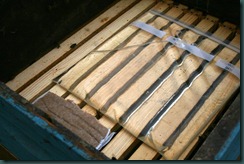
POLLEN Here’s a friend of mine who has a pollen patty on now that it is fall. You can see they have not consumed much of the pollen patty. You might also notice the Ziploc bag full of sugar water with a few holes on top to help feed the bees. Wonder why they are not consuming the pollen patty?
I found out why. He called me in fear that he might have American Foul Brood. He saw a frame that appeared greasy and spotty. So, I ran out the next day and we examined his hive. Though I have never had AFB, I have examined several frames of it in study of my master beekeeper certification. Spending any extended time in the presence of a frame of AFB makes me nauseous because it smells so horrible.
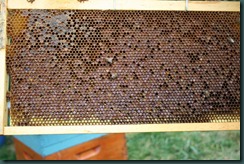
AFBMy friend pulled out the frame under suspect and I’ll let you see it here too. What do you think? Click on the image for a full size picture and see if you know what is wrong with this frame? I’ll give you a minute and then I’ll tell you… His description was accurate. Looks greasy and wet and perforated.
Nothing is wrong! This is a beautiful frame, not of brood, but of bee-bread. Bee bread is a combination of pollen and honey. Take a look at this article on the discovery of what bees do with bee bread:
Scientist solves secret of bee bread from Science News, Nov 5, 1988 by Ingrid Wickelgren
A microbiologist has discovered the microbial ingredients honeybees embed in the nutrient-packed pollen derivative known as bee bread.
Martha A. Gilliam of the U.S. Department of Agriculture's Carl Hayden Bee Research Center in Tucson, Ariz., identified 107 molds, 81 yeasts and 29 bacteria in the bread while she and co-workers sifted through the yellow granules for proteins, lipids, vitamins, minerals, amino acids and enzymes.
Workers bees newly emerged from the comb must eat bee bread so their glands produce food for the queen and developing larvae, whereas older worker bees -- the foragers -- survive primarily on honey.
"We think bee bread is somewhat more nutritious than regular pollen, but until recently, we weren't sure what happened to it [after the bees collected it]," says Elton Herbert, a research entomologist at the Agriculture Department's Beneficial Insects Research Laboratory in Beltsville, Md.
Using standard chemical methods, Gilliam picked apart pollen on its path from plant to hive. She took samples from beeless almond trees, from the carrying basket on the bee's leg and from the combs in the hive.
"We found that as soon as bees touch the pollen on the plant, they are adding glandular secretions, microorganisms and either honey or nectar to make it sticky," Gilliam says. The added microbes produce enzymes that help release nutrients such as amino acids from pollen, and the organisms manufacture antibiotics and fatty acids that prevent spoilage. The bees also remove unwanted microbes from the pollen.
My friend was pleased and overjoyed that his hive did not have AFB, but rather had a good source of bee bread to take into winter and next spring!
PROPOLIS
MYSTERY PHOTO??????
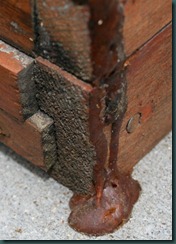
WHAT IS THAT…..
A friend had this dripping out of the edge of his hive. Anyone want to venture a guess? Most beekeepers can quickly identify it as propolis. Indeed it is as I pinched and smelled it. But the real question is why would it run out of the hive and down onto the cement stand. Email us your answers and we’ll publish them in the next lesson. Email your guess to: david@honeybeesonline.com
MICE
Mice like warm places to overwinter. When nightly temperatures drop and farmers harvest their crops, mice look for shelter. What better place than a warm and roomy bottom board of a bee hive. Dead bees are nicely dropped down for the mice to consume. Often, mice and bees coexists without harming the other. In the spring, mama runs out of the hive with her new family. However, usually what happens is the mouse gets greedy and wants more than just dead bees. They start eating live ones, honey, wax, pollen and begin to move up into the brood next of the hive where the heat and food is and by that time, the mouse will kill the hive. It’s challenging enough to overwinter bees, so don’t over winter mice in your hives.
Usually the entrance cleat is sufficient to deter mice from taking up residency in the hive. Do keep mice out! One year I overwintered a nice number of colonies along with huge families of spring mice. That crop of mice then raised me a nice crop of snakes who stayed curled under my hives waiting for mice. So, since I stopped raising mice in my hives, I no longer have snakes either.
That’s all for now and I do hope you’ve learned a thing or two new about beekeeping. Maybe it’s all new and maybe it all sounds Greek. Don’t despair. We beekeepers just like to rattle on and on about beekeeping. But you can be an excellent beekeeper just by keeping it simple. Bees existed fine before we tried to domesticate them, so rest assured your bees will be very forgiving of your learning curve.
WE ARE NOW TAKING ORDERS FOR PACKAGE BEES ONLINE. CLICK HERE TO ORDER Package Bees
Here’s our contact information
David & Sheri Burns
Long Lane Honey Bee Farms
14556 N. 1020 East Rd.
Fairmount, IL 61841

PHONE 217-427-2678
EMAIL: david@honeybeesonline.com
WEBSITE: www.honeybeesonline.com
Until next time, remember to BEE-Have yourself!

Friday, September 25, 2009

Lesson 65: Screen Bottom Boards In The Winter? Fall & Winter Feeding

DavidSheri Hello, we are David & Sheri Burns from Long Lane Honey Bee Farms in Central Illinois.
Today, I want to address a few controversial issues about preparing a colony for winter. For example, screen bottom boards are of tremendous benefit in reducing mites in the summer, but should we leave these open for the winter winds? And, what about feeding bees in the winter? How can we feed bees without the sugar water freezing? Before I address these and other issues, let me remind you of our upcoming beekeeping class.
WARNING: There is a push to make beekeeping appear practically hands free. New beekeepers are failing to implement best management practices. I want to be your mentor. I am currently accepting positions to mentor a limited number of beekeepers. You'll have access to my personal cell phone and private email. And you can send me videos or pictures of your hive when it just doesn't seem right or you don't know what's going on. You'll also receive 4 new instructional videos from me and a weekly tip of what you should be doing. Click here to see if spots are still available.
L653


l664 Those of you who have visited us know why we are called Long Lane Honey Bee Farms. We live down a long lane, a long gravel lane and with heavy trucks coming and going, our road is constantly full of potholes. So, we added Thomas the Tractor to our arsenal against potholes. L663A 1958 Case 800 tractor with a front pallet fork and a rear box scraper. I'm a penny pincher. When we first moved here, I had 5 loads of gravel dumped in piles down my lane and for weeks, my son and I used shovels and rakes to smooth it out. I've been working on Thomas for a couple of weeks, repairing hydraulic lines but now the old tractor has joined the work force at the honey bee farm.
LESSON 66: Screen Bottom Boards In The Winter & Fall & Winter Feeding
In a previous lesson, I shared several approaches on how to prepare for winter. In this lesson I want to go into more detail about screen bottom boards and winter feeding.
Bottom Board 001 Screen bottom boards prove to be very beneficial in the summer for reducing mites and for increasing ventilation. But do they pose a threat to a colony during the winter? That's a debated issue. Some cover their screen bottom boards while others leave them open. A few years ago, we did a simple test. We placed covers over 3 colony's screen bottom board and left the others open. We lost all three that were covered. So we always leave our screen bottom boards open all winter. It is our opinion that an open screen bottom board cuts down on excessive moisture. Cold air sinks and warm air rises, so the threat of an open screen bottom board, in our opinion, is minimal.

If your hive is up in the air 6 or 8 inches, then you want to prevent cold wind from curling up and blowing onto the cluster. This can be accomplished by building a wind block around your hive.
Remember, that a winter cluster warms only the cluster and not the inside of the hive. On an extremely cold night, the air several inches away from the cluster will be the same as outside the hive. The bees consume honey, and vibrate by flexing their muscles to generate heat, much like we do when we shiver. That heat is transferred throughout the cluster. They will be able to accomplish generating the cluster heat with or without the screen covered.
WHAT ABOUT WINTER FEEDING?
Many beekeepers allow their colonies to become extremely undernourished. Pollen and stored honey is essential to winter survival of colonies. In the fall, I work to beef up my colonies. It's tricky for me because of the number of colonies in one location. Even an inside top feeder can create a robbing frenzy. In the fall, boardman feeders placed in the front of hives is a certain robbing disaster.
So my approach is two fold. 1) During the fall only, after most nectar is no longer available, I want to prevent robbing, and 2) I want to beef up my colony nutrition for winter.L662
You can click on the images for a larger view. My approach is simple. I do use boardman feeders, but I place them on stands throughout the bee yard. And on dry days, I pour dry pollen out on the feed stands. My sugar mix is two parts sugar and one part water for fall. I have to make the holes bigger in the lids for the syrup to pass through. I also add one teaspoon of Honey-B-Healthy.
Winter-Bee-Kind For Winter Feed For Bees
In The summer of 2011 we introduced our Winter-Bee-Kind after several years of studying overwintering hives. We could barely keep up with production they were in such demand. We still make them right here at Long Lane Honey Bee Farms but we've expanded our production methods to keep up with demand. So many beekeepers told us that these were the only thing that got their hives through the winter. This year, it's time for the 2014 production year. We even mix the sugar and pollen and right here and pour the candy into the Winter-Bee-Kinds. WHAT IS A WINTER-BEE-KIND? It is a one piece candy board that provides food, ventilation, upper insulation and an upper exit/entrance to help bees remain healthier during the winter. Someone said it insulates, ventilates and feed-i-lates. With the built in upper vent, you don't have to worry about snow covering up your hive's lower entrance. The bees can still go in and out through the top vent spacing. We avoid shipping Winter-Bee-Kinds in hot weather and start shipping each September-March. You can place our Winter-Bee-Kinds on your hive anytime, even in the winter. Because it goes on top of the hive in place of the inner cover, and you are NOT removing any frames, it can be placed on the hive in cold weather. Just do it fast. Open the top, remove the inner cover and place the candy side down and the vent slot toward the front of the hive and you're done. Click here to order your Winter-Bee-Kinds Some form of a candy board has been around for a long time. Beekeepers of long ago placed candy in their hives to provide enough food for their bees to survive the long months of winter. There are various mixtures and receipts for candy boards. Some are made with soft candy and some with hard candy. The end result is still the same. The bees will consume the sugar as they need it. We've always been concerned about the amount of condensation that can develop in the hive during the winter. The bees produce heat within their hive and as the temperature is very cold outside the hive, condensation will develop on the warm side, just above the bees on the inner cover or top cover. This condensation can accumulate and drop down onto the winter cluster of bees below. Bees can stay warm in the winter but they must remain dry. If this cold water drips down onto the bees, it can reduce their ability to keep their cluster warm. The insulation on our Winter-Bee-Kind helps reduce the excessive moisture and even puts some of that moisture to work, as it accumulates on the candy and makes it easy for the bees to consume the sugar. Thus, a Winter-Bee-Kind can help lessen two winter stresses, the lack of food and excessive moisture. We make our Winter-Bee-Kinds with sugar and a healthy amount of pollen powder. Many beekeepers make the mistake of only feeding their bees sugar in the winter, but the bees also need protein which they obtain from pollen. Our Winter-Bee-Kinds come with pollen mixed in with the sugar.. Click here to order your Winter-Bee-Kind today. We recommend that you place candy boards on your hive any time between Oct-March.

Commonly Asked Questions
Q: Which way does the candy face in the hive?
A: The candy faces down just above the winter cluster. Normally, this means that the Winter-Bee-Kind would be placed on the brood box that contains the cluster. For example, if you overwinter your bees in a single deep hive body, the Winter-Bee-Kind would be placed on this deep hive body with the candy facing down toward the cluster. If you are using two deep hive bodies to overwinter, then the Winter-Bee-Kind would be placed on the top deep hive body. It is best to disregard the use of an inner cover, and simply place your top cover over the Winter-Bee-Kind.

Q: What about winter moisture?
A: Moisture can develop in the winter from condensation, a contrast of the heat the bees produce in the hive and the extreme cold temperature outside the hive. Condensation accumulates on the warm side, which means moistures collects on the inner cover or top cover above the hive. This can drip down on the bees and chill them during the winter. A Winter-Bee-Kind takes the place of an inner cover and any moisture that develops from condensation aids the bees in consuming the candy.

Q: How long will a Winter-Bee-Kind last on a hive?
A: On average about 3 weeks. However, a colony that has ample stored honey may not consume the candy board as fast or not at all until they need it. A colony close to starvation may consume a Winter-Bee-Kind within a week or two.

Q: Since Winter-Bee-Kinds are placed or replaced on the hive in the winter, can I open the hive up on a cold day?
A: It is best to place the candy boards on a hive when the temperature is above freezing and try to place the candy board on and have the hive sealed back up within 1-2 minutes. It should not take over 1 minute. Do not remove any frames in cold temperatures, only place your Winter-Bee-Kind on and off quickly. If you can choose the warmest day during the winter, that would be best. Try to avoid very cold, windy or rainy days.

Q: How do I refill a candy board?
A: It is best to send back your candy board and we will refill it for $7 plus shipping. If you are a good candy maker, you can do it yourself.

Q: How do I get one with a pollen?
A: Our Winter-Bee-Kinds contain pollen as well.

Q: Can I make my own?
A: You can, but you must experiment, because you do not want the candy to be too hard or too runny. The exact mix depends on your altitude, heat source and other conditions so it will be different from one location to another.

Q: Why was some liquid sugar dripping out of my Winter-Bee-Kind when I received it?
A: It is the nature of candy boards to be a bit on the dripping side even though the top may be hard. Do not be concerned if you see liquid sugar dripping out of your boards when you receive it. It usually means it was left on end during shipment for a prolong period of time. The bees will clean everything up and enjoy this soft liquid.

Q: How much sugar is in one Winter-Bee-Kind?
A: Approximately 5 pounds

Q: When do I put a Winter-Bee-Kind on my hive?
A: Any time! Nov, Dec, Jan, Feb are good months to place on the boards.

Q How often should I check my Winter-Bee-Kind?
A: Every three weeks, take a peek.

Q: Do you make Winter-Bee-Kind for 5 frame nucs or 8 frame hives?
A: Yes, check out our website to order, but carefully read the description to make sure you are ordering the correct size and type.

Q: Can the candy break loose from the board on the hive?
A: It rarely happens, but during extreme winter weather, the candy and separate from the board while on the hive. This is not a problem. The bees will continue to consume the sugar.

Q: When I place it on the hive, do I use my inner cover. Just how does it go on?
A: Winter-Bee-Kind takes the place of your inner cover. Simply place the Winter-Bee-Kind on the top of your upper hive body or super with the candy facing down, then place your top cover on top of the Winter-Bee-Kind. Be sure to use a rock or brick to make sure the wind does not blow your top cover off. There is overwhelming enthusiasm about our Winter-Bee-Kinds. Click here to order now.
Bee Factory 212 Feel free to order your hives for the spring by calling us at 217-427-2678. We take credit cards over the phone, or you can order online by clicking here.
We always appreciate your business, whether it is for your woodenware hive needs, queens, packages, nucs, clothing or extraction equipment, we always appreciate your loyalty.
Here's how you can contact us:
Phone: 217-427-2678
Email: david@honeybeesonline.com
Web Address: http://www.honeybeesonline.com/
It's easy for you to sign up to receive these Lessons right to your Email address. It is free and you can unsubscribe at any time. Just enter your email address below and click on Submit Query. Please spread the word about these lessons to others who may be interested in learning more about beekeeping.


Enter your Email


Preview Powered by FeedBlitz
Check out our Beekeeping Podcast at: www.honeybeesonline.com/studiobeelive.html
Until next time, remember to BEE-Have yourself!

David & Sheri Burns
Long Lane Honey Bee Farms
Fairmount, Illinois

Sunday, March 16, 2008

Lesson 30: Spring Management Of Overwintered Colonies, Part I

We've had many pleasant visits to our business over the last few weeks, people buying and picking up hives and supplies and asking lots of beekeeping related question. The phone is ringing off the hook, so if you get a busy signal call back, and if you leave a message, be patient as it may take a day or two for us to get back to everyone.
We continue to be so blessed by meeting more and more wonderful people because of our bee business. Frank Schumacher has travel the farthest, all the way from Germany. Well, I don't think he came over to the US just to see me, but certainly he drove down from Chicago. He's a beekeeper in Germany and we swapped great stories, photos and practices.
We have received many phone calls and E-mails from people who have been attending bee schools and reading materials on beekeeping. This is good. However, many people have been confused over what some bee schools teach and practice that are a bit complicated and confusing. Remember, everyone in beekeeping has an opinion. It doesn't mean it is right or wrong, it just means you must remember that what works for one beekeeper may not work at all for you. He keeps his bees in a beehouse and as soon as he gets back home he'll send me some photos and I'll share them with you.
We are creating web pages with our beekeeping lessons so that they can be more easily accessed and searched, but it is a slow process. And, my wife and I have decided that we will hold our first beekeeping school here on our honey bee farm in October. Students will not only have class instructional time, but time in the field for side by side beekeeping mentoring.
Our family and friends are working very hard to keep up with the hive orders. I will be making my second trip to Liberia, Africa in just 8 days, and will be gone from March 25 through April 5, so if you try to reach me, I will be unavailable. africapreaching However, please place your confidence in speaking to my wife. She is very knowledgeable about beekeeping and can certainly answer your questions. She helps me work the bees, so she knows what she is talking about. In 2005 I led a group of adventurous people from our church into the war torn country of Liberia. Our church started an orphanage in Liberia, and while there, we walked the streets and villages and visited homes sharing the hope and love of Jesus to those who seemed to have lost all hope due to the plight of their country's enormous civil war that killed millions. Please pray for a safe and successful trip for us.
Another important work I must complete before I leave is to be sure all my hives that made it through the winter are well fed and have plenty of space for rapid spring build up. It is a challenge.
This winter, I spent much more time researching what a hive does in the winter, how they manage to survive cold weather and how the cluster behaves. I was very surprised in what I found out. Let me share with you what I have discovered and what conclusions I have drawn based on my research and how this will help you manage your overwintered colonies.
THE QUICK SUMMARY OF WHAT I DISCOVERED:
...that working bees when it is at least 30 degrees Fahrenheit can be successful if done very quickly, within a minute or two.
...that the cluster size is critical to colony survivability.
...that we cannot afford to winter our bees with bees that emerge in August. Bees that emerge in October and November are essential to maintain cluster longevity and endurance into February and March.
...that bees protecting January and February brood will not leave that brood in cold weather and feed on nearby honey. They will die before traveling a few frames over to the food source.
...that bees need pollen patties no later than Feb 1st.
...that it is very effective to place pollen patties and sugar water directly above the winter cluster.
PHOTOS & DETAILS OF WHAT I DISCOVERED DURING THE WINTER OF 2008.
Traditionally, beekeepers are told that as long as the hive has 80 pounds of honey, they'll make it through winters up north. And, that's about all beekeepers have done, left plenty of honey in the hive and maybe wrapped some roofing paper around the hive, and accept the fact that there is always a 20-50% expected loss.
To me, that's a bit lazy. To do so little, and settle for such losses is unacceptable to me. My bees are worth more than that to me, and I don't mean financially, but these are my bees that I have been entrusted to care for. Surely I can do better than this. That's why I put extra time in research and monitoring my hives this winter.
Beekeepers often lose hives that have plenty of honey and they usually guess as to why they died with plenty of food. They will say that maybe the Tracheal mites got 'em or maybe the queen died in the fall or maybe it was just too cold or too wet or they had Nosema. Certainly these are possibilities. However, many winter deadouts are caused from poor management...pilot error that could have easily been avoided.
I believe we should work our colonies as soon as we can. Pollen patties should be placed in our hives no later than February 1st. Pollen patties will stimulate the queen to start laying more, while providing the bees some nutrition. Even when it is cold outside, we can quickly open our hives on the warmest day in January with no wind and slide a pollen patty over the top of the winter cluster. lesson2c See this photo of a winter cluster in one of my hives. This is the top of the cluster in the second deep hive body. Then, I simply slide in a pollen patty and let it sit on the top of the frames right above the cluster. I turn my inner cover up-side-down so that the wooden rail is down, allowing more of a gap between the frames and the inner cover to accommodate the spacing needed for the patty. I can do that in less than 30 seconds. In this photo I placed an empty deep hive body on top of the second deep, so that I can feed the bees more easily with sugar water in a jar. Then I put my top cover on top of the third deep box.
lesson28When placing the patty in the hive, LEAVE THE PAPER ON!! If you take it off, the patty will become too moist and can mold. The bees will remove the paper themselves. I know you don't like eating your cheeseburgers with the wrapping on, but the bees do!

CLUSTER SIZE is crucial for hive survivability and endurance into February and March. The colder it is the larger the cluster needs to be. lesson28b That's why hives die in March. Naturally, the cluster is very small in March, and if there is a severe cold snap, a very small cluster cannot stay warm. This cluster is probably not going to make it. They are too small because the queen stopped laying early, probably in August or September and the bees simply died of old age reducing the number in the cluster. We must work our hives in the fall so that the queen continues to lay into October and November. Again, the easiest way to do this is to feed the hives pollen patties and 1:1 sugar water.
Then, people will ask, "But a larger cluster means they will consume more food and possibly starve". Again, what good is it to have a small cluster and 80 pounds of honey and the small cluster dies and the honey is not consumed at all? Take a large cluster of younger bees into winter and if they consume their 80 pounds of honey be February 1, it doesn't matter because you can beginning feeding them pollen patties and sugar water. They'll stay warm with plenty of food. Remember, the cluster generates the heat.
PROTECT THE BROOD OR MOVE OVER TO A FRAME FULL OF HONEY?
lesson2d Here is a picture of a dead hive that was doing well in early February but died after a very cold snap in late February. They still had 50 pounds of honey three frames over. The queen started laying in late January or early February, as you can see the winter brood in the lower left hand corner of the frame, but the cluster was too small. As a result, the small cluster made one last ditch effort to keep the brood warm, yet were unable to move vertically over to the frames with honey. If they had, they would have become paralyzed by the cold and died away from the cluster and the brood would have died as well. They froze and starved with 50 pounds of honey five inches away. So typical. Had I moved the honey over next to the frame with brood on it, they would have made it fine.lesson2j For example, this is what i did on on another hive. In this picture you can see how I placed a super of honey on top of the top deep hive body containing the winter cluster. You can click on the image for a larger image. Since heat rises, the top of the cluster was able to move up a bit into the super with honey temporarily to eat.
This is why beekeepers must work their hives in February. Frames of honey must be slightly scratched open and moved over next to the cluster.lesson28j DO NOT disturb the cluster, but move the frames of honey either right beside the cluster or directly above it. I placed this pollen patty on Feb. 1 and in 23 days they had consumed half of the patty.

Another effective way to help the bees along is to give them sugar water, 1:1 ratio. This is a bit more tricky, because water will freeze during the winter. I found one method that works great for me. I place sugar water in a ziploc sandwich bag and poke three holes in the top of the bag with a needle or a pen. I don't want the water to drip out, but just make a very small pool on top of the bag. As the bees move onto the bag, more sugar water comes out. lesson2iAnd above the cluster area, it will not freeze. In one month they emptied this bag. I know you'll ask what that strip is between the bag and pollen patty so I'll tell you. It was a larger piece of comb that had honey in it. I removed it from another super and just laid it on top. On the pollen patty you can see where they have eaten the pollen beneath the paper.
FEEDING BEES IN THE SPRING...
Once we begin feeding our bees pollen patties and sugar water, it is best to continue until natural pollen and nectar is available. If we stop feeding, then the queen would have laid lots of eggs, but there would be no sources of pollen and nectar to raise her young. You've fooled her in the worst way. She's a good momma. She will not have kids unless she knows the colony can feed them. If you tell her you'll do the providing until spring comes, then keep your commitment to her and her daughters. Once nature starts producing nectar and pollen you can discontinue feeding both sugar water and nectar on over wintered colonies. However, in newly installed packages you must continue feeding sugar water, 1:1 for as long as they still have comb to draw out. They turn sugar water into wax for the building of their comb. But on over wintered colonies, their comb is already built out from last year. This is why second year hives produce more honey. Incoming nectar can be stored, not converted to wax.
That's enough for today...In our next lesson I'll give you more tips on what to do with your over wintered hives as spring approaches.
lesson28l A customer in Texas sent us photos of the hives he bought from us. They look great don't they! If you'd like to email us a photo of your hives in action, in your yard, we'd love to put them on our web site.
Please keep our contact information close at hand. If you have questions or would like to order hives, bees or beekeeping supplies, give us a call: 217-427-2678. If you'd like to order directly online, go to: www.honeybeesonline.com
Email us at: david@honeybeesonline.com
Remember, BEE-Have Yourself!

davidsheriDavid & Sheri Burns
Long Lane Honey Bee Farms